Showing posts with label Housing. Show all posts
Friday, December 16, 2011
Residential Development | Wave in Vejle | Vejle | Denmark | Henning Larsen Architects
The new landmark of Vejle is a distinctive residential building of nine storeys with a magnificent location by the bay Skyttehusbugten and Vejle Fjord.
With its five characteristic wave crests, the Wave in Vejle stands out as a sculptural icon both respecting and challenging its location.
Architecturally, the building relates to its fantastic location by Vejle Fjord. In daytime, the building will be characterised by the soft movements of the waves reflected in the water surface of the fjord. At night, the characteristic profile of the Wave will appear as an undulating mountain landscape of light and colour.
The building comprises 100 attractive flats - many of which are in two levels. The layout of the flats ensures a splendid view from all balconies. Together with the public promenade in front of the building, the Wave creates a beautiful connection between the fjord, landscape and town and consolidates the different elements in a clear and recognisable signature. .......more
Friday, September 9, 2011
Housing Design | Suburbia + Inner City | Brooklyn | New York | Pinkcloud
Can Suburban Lifestyle exist within the Inner City?
Has modernism become our antiquity? This project seeks to address issues of density and public housing in New York City, but in doing so, also questioning architecture’s ability as force for social change and development. The project calls for the revitalization of the Wyckoff Gardens public housing project located in Brooklyn’s poverty stricken Gowanus neighborhood......more
Wednesday, August 17, 2011
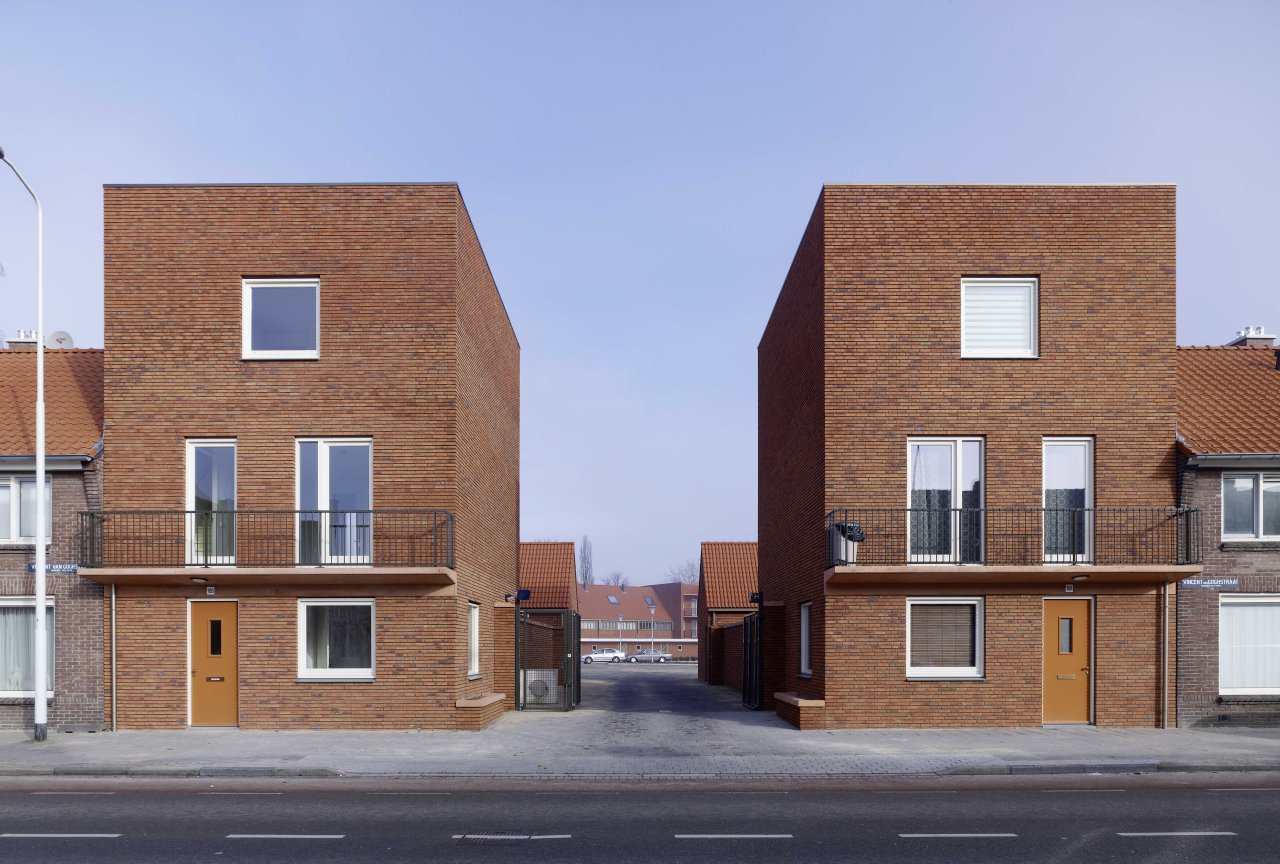
Housing Development | Garden City | Eindhoven | The Netherlands | biq
" We have reconstructed one part of the district with houses lining a square, a court, an alley, streets and a green boulevard. The conventional urban spaces are supported by equally conventional house types. Corners and long facades are marked by special forms of living: combined living and work units, accommodation for mentally disabled and their attendants. Cars are parked within the perimeter of the blocks.".......more
Monday, July 11, 2011
Housing And Cultural Centre | Xi Gallery | Pusan | Korea | Mass Studies
Located in Yeonsan-dong, Pusan, this building was constructed for the purpose of promoting "Xi," a brand of apartments. In addition to the standard type of an apartment unit exhibition space (a common practice in Korea to publicize and market prospect constructions), a even larger share of the floor area is allocated as a variable cultural space for the locals, which as a result creates a brand-new building typology: a Housing Cultural Center.......more
Thursday, July 7, 2011
Hanasaari Residential Development | Tropaion | Helsinki | Finland | ALA
The scheme, called “”, consists of five perimeter blocks of varying heights covered with roof terraces of the upper apartments. The blocks form a gigantic bowl shape with crossing sea views from all terraces and a sense of community and togetherness for the people.
The courtyards will form semi-private spaces, which the residents of Helsinki are very fond of, and public streets with shops and services at street level. Building heights vary from 16 floors down to two, with varying housing typologies and apartments sizes included in the same blocks.............more
Sunday, June 26, 2011
Residental Development | Apartment building | Woonbedrijf Ieder1| Deventer | The Netherlands | KCAP
'Het Baken' (The Beacon) is part of Deventer's vinex area Vijfhoek, a residential development dominated by two and three-storey houses. In order to relieve this monotony Het Baken presents itself as a highly distinctive residential building realised on one of the last free plots. The block has the appearance of a boulder, an asymmetrical cube with a skin of slate whose massive form provides space for 22 apartments and a daycare centre. The canted, faceted contour was arrived at on the basis of sight lines and the effect of shadow. In terms both scale of design and materialisation, Het Baken cuts a striking figure. The block rises cliff-like above the bland vinex landscape, providing a welcome landmark from whatever direction it is viewed.
The ground floor acts as a transparent plinth, with the building volume jutting out on two sides above it. The plinth houses the daycare centre whose glazed facades provides plenty of contact with the surroundings........more
Saturday, June 18, 2011
Residential Development | Von Galen-Street | Marl Germany | Petersen Architekten
Existing postwar houses would be replaced by new buildings, which ones will garantee a modern living quality. The option is a variability of floor plans as well as the building services engineering. The technical „Manpower“ of the housing company should be able to accomplish all later changes.
The buildings follow essentially the alignment of the existing houses, in order to preserve the tree population on the property. Seven existing buildings with a renting surface of 2,725 m2 are replaced by eight new houses with 3.821 m2 renting surface divided in 48 housing units. (In a second construction stage 2-storeys appartment buildings could be added on the garden side and add 848 m2 renting surface in 16 housing units). ......more
Sunday, June 5, 2011
Student Work | Architecture G | Vertical Workshop 2010 | Housing In Sahara
The student team led by ARCHITECTURE-G, won an honorable mention in Vertical Workshop 2010. The proposed prototype, called Isotropic, consists of a housing organization system for political refugees in the Sahara. This is an infrastructure that provides 6 rooms of 2.5 × 2.5 m to each family of 6. (A patio, two rooms covered in PB, a room covered with double height ground floor and two rooms covered in P1). We designed a housing scheme to provide flexibility of use and generate spatial and thermal situations. Although the system can be organized in grid or cluster, their virtue is the spontaneous growth in any direction, the non hierarchical, rhizomatic, without staking. The house is light, recyclable and transportable in a 125x250x60cm packaging.
Monday, May 30, 2011
Day nursery and housing units | Lingolsheim | France | LAN Architecture
The success of the project to build housing units and a day care centre in the Media Library sector depends on its capacity to respond to diverse urban planning and architectural problems. On the town planning level The project has to create a new polarity with the focus on the media library, clearly defining public spaces and thus differentiating their flux. The new ensemble has to act as a fulcrum between several streets (avenue Schuman – rue de la Bibliothèque, etc.)........more
Tuesday, April 19, 2011
Multi-family residential | Centre Village Winnipeg | 5468796 Architecture
Centre Village is a 25-unit housing co-op located on a small infill lot in Winnipeg’s Central Park neighbourhood. The project strives to create a true community – a housing village – with modest means. The design is based on simple, 8’ x 12’ modules organized on a central spine. Occasionally, the base module is replaced by a larger 14’ x 12’ unit that cantilevers off the main spine to accommodate living quarters. All upper units have their own rooftop patio, and second-storey units are accessed by exterior staircases......more
Sunday, April 17, 2011
Residential Development "Flacara" in Cluj-Napoca | Romania | Albert Speer and Partner
LBBW Real Estate acquired a property in the center of the 3rd largest city in Romania. The property, to consist of a mix of residential and commercial uses, is to be built to the highest architectural standards. AS&P's design, which prevailed over various prestigious contenders in the competition, refrains from fully exploiting the property for the benefit of quality. This sustainable approach of the design also convinced the client. Five high-rise buildings with various uses, individual arrangement and coordinated height development coin the "Flacara " ensemble......more
Friday, October 22, 2010
Single Family House | 18.36.54 Connecticut, USA | Studio Daniel Libeskind
The living space of this Connecticut residence is formed by a spiraling ribbon of 18 planes, defined by 36 points connected by 54 lines. This pure and dynamic architectural form generates distinctive interior spaces while dramatically framing both near and distant landscape scenes. Large glass planes virtually disappear within the ribbon, allowing unimpeded picturesque views of 18th century hay meadows and giant oaks. Circulation through kitchen, living, dining, and sleeping areas is seamless and free-flowing, as is the distinction between interior and exterior space. Challenging both traditional and modern notions of “the house in the landscape,” this design gives nothing of itself up to its natural setting, but selectively incorporates the elements therein for the enhancement of both house and landscape.Pictures of that single family house here
Commission: January 2007
Completion: 2010
Technical Details:
Single-Family House
Building Area:2,000 sq.ft.
Structure:Steel
Credits:Structural Engineer:Hage Engineering, PC
Mechanical Engineer:P.A Collins, P.E
Civil Engineer: CCA Engineering, LLC
Lighting Designers:ARUP Lighting
Windows:Steel Windows & Doors USA
Building Science Consultant:Simpson Gumphertz & Heger
Contractor: CN Renovation Co., Inc
Facade Contractor:A. Zahner Company
Commission: January 2007
Completion: 2010
Technical Details:
Single-Family House
Building Area:2,000 sq.ft.
Structure:Steel
Credits:Structural Engineer:Hage Engineering, PC
Mechanical Engineer:P.A Collins, P.E
Civil Engineer: CCA Engineering, LLC
Lighting Designers:ARUP Lighting
Windows:Steel Windows & Doors USA
Building Science Consultant:Simpson Gumphertz & Heger
Contractor: CN Renovation Co., Inc
Facade Contractor:A. Zahner Company
Thursday, October 7, 2010
New High Design Flats on the River Rhine: Kameha Residence Dusseldorf By Tec Architecture
Tec Architecture sent us their latest work on the River Rhine for the same developer ( Cosmopolitan Estates ) that gives us Casa Son Sida.
"As it happens, Cosmopolitan Estates' hospitality and entertainment arm: Lifestyle, Hospitality, and Entertainment Group (LHEG) has just launched a new project in Dusseldorf, Germany.
LHEG recently launched the Kameha Bonn resort (super luxury hotel designed by Marcel Wanders) to much acclaim and is now launching a new line of residences under the "Kameha Residence" label. Kameha Residence Dusseldorf is the first of this new line. Located in Dusseldorf, an up and coming art + design capital in Germany with a burgeoning creative industry, the new project offers high design spaces along the river Rhine. Three different design concepts, very edgy, very modern - designed by tec architecture (the same company that designed Cosmopolitan Estates' Casa Son Vida in Mallorca). It's all part of a movement to redevelop the old Rhine harbor area. It's also an ambitious adaptive re-use project - super mod residences built within the walls of the old Theriesen hospital, the oldest building in Dusseldorf and a registered national landmark (built 1831). The Kameha Residence Dusseldorf is slated for completion in early 2012. Units will be available for purchase as of October 2010."...images here
You can also visit Tec Architecture website here
Tuesday, September 21, 2010
Terreform | Homeaway-The Great Suburban Exodus
Credits: Mitchell Joachim, Maria Aiolova, Melanie Fessel, Philip Weller, Ian Slover, Landon Young, Cecil Howell, Andrea Michalski, Sofie Bamberg, Alex Colard, Zachary Aders.
How can our cities extend into the suburbs sustainability? We propose to put our future American dwellings on wheels. These retrofitted houses will flock towards downtown city cores and back. We intended to reinforce our existing highways between cities with an intelligent renewable infrastructure. Therefore our homes will be enabled to flow continuously from urban core to core.
Our proposal envisions an immense and vital solution to a fundamental problem: American suburbs fail to work efficiently. In the next 25 years we will build 56 million new homes that will consume 18.8 million acres of virgin land and emit 7.3 billion tons of CO2 per year. These frameworks of development need to be rethought to meet our ecological carrying capacities. Why should we put further energy into past inferior patterns? America needs to deliver dwellings closer to our existing main infrastructural arteries. We cannot continue to overextend our thinly disturbed resource lines.
America has always been a nation on the road. We desire to move the suburbs on smart networked wheels. We intend to affix a diverse range of mobility mechanisms to home units that generate our novel HOMEWAY system. In the future, the physical home will remain permanent but its location will be transient. Our static suburbs will be transformed into a dynamic and deployable flow. Houses will have the option to switch from parked to low speed. Homes, big box retail, movie theaters, supermarkets, business hubs, food production, and power plants will depart from their existing sprawled communities and line up along highways to create a truly breathing interconnected metabolic urbanism. Dense ribbons of food, energy, waste and water elements will follow the direction of moving population clusters.....more
How can our cities extend into the suburbs sustainability? We propose to put our future American dwellings on wheels. These retrofitted houses will flock towards downtown city cores and back. We intended to reinforce our existing highways between cities with an intelligent renewable infrastructure. Therefore our homes will be enabled to flow continuously from urban core to core.
Our proposal envisions an immense and vital solution to a fundamental problem: American suburbs fail to work efficiently. In the next 25 years we will build 56 million new homes that will consume 18.8 million acres of virgin land and emit 7.3 billion tons of CO2 per year. These frameworks of development need to be rethought to meet our ecological carrying capacities. Why should we put further energy into past inferior patterns? America needs to deliver dwellings closer to our existing main infrastructural arteries. We cannot continue to overextend our thinly disturbed resource lines.
America has always been a nation on the road. We desire to move the suburbs on smart networked wheels. We intend to affix a diverse range of mobility mechanisms to home units that generate our novel HOMEWAY system. In the future, the physical home will remain permanent but its location will be transient. Our static suburbs will be transformed into a dynamic and deployable flow. Houses will have the option to switch from parked to low speed. Homes, big box retail, movie theaters, supermarkets, business hubs, food production, and power plants will depart from their existing sprawled communities and line up along highways to create a truly breathing interconnected metabolic urbanism. Dense ribbons of food, energy, waste and water elements will follow the direction of moving population clusters.....more
Friday, September 17, 2010
Henning Larsen Architects | The Wave Vejle,Jylland, Denmark
The Wave in Vejle is a new unique housing and with its sculptural and organic forms it will become the new landmark of Vejle. With the magnificent location overlooking the promenade and the bay the characteristic building both respects and challenges the potential of the area.
During the day the white waves are reflected in the sea and at night the characteristic profile will look like illuminated multi-coloured mountains. The building has 140 attractive apartments many with two-story house plans, all with a wonderful view.
The Wave is inspired by the characteristics of the area: the fjord, the bridge, the town and the hills. The clear and easily recognisable signature of the building connects the residential area with the sea, the landscape and the town....moreWednesday, September 1, 2010
Foster-Partners | The Murezzan | Housing Project | St Moritz, Switzerland
Located in the Upper Engadine, one of Switzerland’s most scenic valleys, St Moritz receives up to a quarter of a million visitors a year, who are attracted to the famed natural beauty and alpine pursuits. The practice designed the Murezzan Housing Development to be a complement to the unique civic environment of St Moritz, and a unified combination of contemporary and historic elements. The project resulted from a close working relationship between Norman Foster, the client AG Post und Merkatorium, and the project design team.
The Murezzan involves the complete refurbishment of two existing buildings, the Albana Hotel (1907) and Posthotel (1908), and the construction of one new building, the Chesa, to provide a mixed-use residential development which includes sixty apartments. The Foster studio researched the original plans in order to renovate the existing buildings, which had suffered a series of ill-conceived alterations. The design is inspired by vernacular tradition, with proportions and materials, such as timber, concrete, and the distinctive Sgraffito rendering, which refer to local precedent. Bay windows are used throughout to accentuate the lake views and draw inhabitants into the spectacular alpine landscape. A rich mix of ground-level retail has been reinstated to animate the buildings and engage passing pedestrians.
The Murrezan balances urban sensitivity with domestic comfort. Drawing from the hospitality industry, the Foster design combines the warmth and tradition of the family hotel with the grand hotel’s extroversion and comfort, and the designer hotel’s fashionable and informal charm. Each of the apartments is unique, reflecting the diversity of the original buildings, the demands of different lifestyles, and the sophisticated residential market. The practice’s signature contemporary interior design is allied with more traditional elements, such as fireplaces and wooden floors, which are familiar icons of an alpine lifestyle.
The buildings are linked to one another through sky bridges and an underground passage that leads to the underground parking facilities. Views have been maximised throughout. The original entrance to the Posthotel is restored, revealing lake views, and the Chesa juxtaposes retail on the northern urban side, and residential on the southern lake side. All of the apartments are fully serviced and the Murezzan development also includes a restaurant with a bar and lounge, shops, a fitness centre and associated amenities, and 130 subterranean car parks.....more
The Murezzan involves the complete refurbishment of two existing buildings, the Albana Hotel (1907) and Posthotel (1908), and the construction of one new building, the Chesa, to provide a mixed-use residential development which includes sixty apartments. The Foster studio researched the original plans in order to renovate the existing buildings, which had suffered a series of ill-conceived alterations. The design is inspired by vernacular tradition, with proportions and materials, such as timber, concrete, and the distinctive Sgraffito rendering, which refer to local precedent. Bay windows are used throughout to accentuate the lake views and draw inhabitants into the spectacular alpine landscape. A rich mix of ground-level retail has been reinstated to animate the buildings and engage passing pedestrians.
The Murrezan balances urban sensitivity with domestic comfort. Drawing from the hospitality industry, the Foster design combines the warmth and tradition of the family hotel with the grand hotel’s extroversion and comfort, and the designer hotel’s fashionable and informal charm. Each of the apartments is unique, reflecting the diversity of the original buildings, the demands of different lifestyles, and the sophisticated residential market. The practice’s signature contemporary interior design is allied with more traditional elements, such as fireplaces and wooden floors, which are familiar icons of an alpine lifestyle.
The buildings are linked to one another through sky bridges and an underground passage that leads to the underground parking facilities. Views have been maximised throughout. The original entrance to the Posthotel is restored, revealing lake views, and the Chesa juxtaposes retail on the northern urban side, and residential on the southern lake side. All of the apartments are fully serviced and the Murezzan development also includes a restaurant with a bar and lounge, shops, a fitness centre and associated amenities, and 130 subterranean car parks.....more
Friday, July 24, 2009
Housing | Butterfly Huts | Noh Bo,Thai-Burmese border | Tyin Tegnestue


Architect: Tyin Tegnestue
Designers: Pasi Aalto
Staff: Pasi Aalto Grøntvedt Andreas Gjertsen Yashar Hanstad Magnus Henriksen Line Ramstad Erlend Bauck Sun
Project Type: Modular Housing Unit
Client: Ole Jørgen Edna
completion: 2008 | 2009
Link: www.tyintegnestue.no
Project Description:
Tyin Tegnestue is a humanitarian organization founded on the initiative of the Faculty of Computer Science at the Norwegian. Financed by more than 60 Norwegian companies, as well as other private contributions, the organization Tyin work in the field of architecture with the goal of helping people in distress.
The draft of the "Butterfly Huts" ( "Capanne butterfly", so named by virtue of the special geometry of the roof that is reminiscent of the wings of a butterfly) was created in response to the need to provide more housing for the children Karen refugees in Noh Bo, a small village that lies along the Thai-Burmese border. Completed in February this year, the six cabins now offer hospitality to 24 orphans.
Built with environmental sustainability, the six huts are made of prefabricated and assembled on site. The bamboo used was produced from local reserves (a few kilometers from the intervention), and is woven in traditional houses as the place.
The form "winged" roof helps the natural ventilation, and also contributes to the collection of rainwater, which is useful in times of drought.
The problems of moisture and deterioration have been solved by raising the ground construction, which are based on four old tires used as a foundation plan.
"Fundamental principles such as economy of materials and prevention of moisture - say by Tyin - are laying the foundations for sustainable construction of the future."
Via archiportale
Thursday, July 23, 2009
Grouped Housing | NEW SEIFULLIN CENTER | ALMATY, KAZAKHSTAN | Neil M Denari Architects


2007-08
A New Kazakhstan
Since 2000, Kazakhstan has significantly emerged as a center of Eurasian free market systems. With an oil rich economy and nearly seventeen years of successful reforms under the leadership of President Nazarbayev, this country of fifteen million people stands at the edge of a major leap into global business leadership. As such, the rapid development of it’s largest city, Almaty, has given rise to new landscapes of diverse elements, mostly notably among them the Samal District located in the heart of the city.Through architecture, individuals and corporations alike, find identity in a world where money, borders, and cultures are rapidly changing people’s lives.
Site Organization
The site is zoned in two parts based on a rational split between Office use and Residential use, with circulation elements and the retail component as the functions that bridge these two zones.
To the north, occupying roughly 2/3rds of the site, the residential buildings are configured so as to respond to the streets surrounding the site, to the maximization of views, and to the creation of a rich spatial experience on the main site plaza. On the southern zone of the site, the Office program sits directly north of the Foster twin tower, creating a buffer between it and the residential zone. This building is set back from the site edges as an elegant sculptural volume, the connecting bridges that emerge from a 13 story high void.
Text and images from Neil M Denari Architects
Tuesday, May 26, 2009
Students House in L'Aquila | Tecno Adler
Subscribe to:
Posts (Atom)